

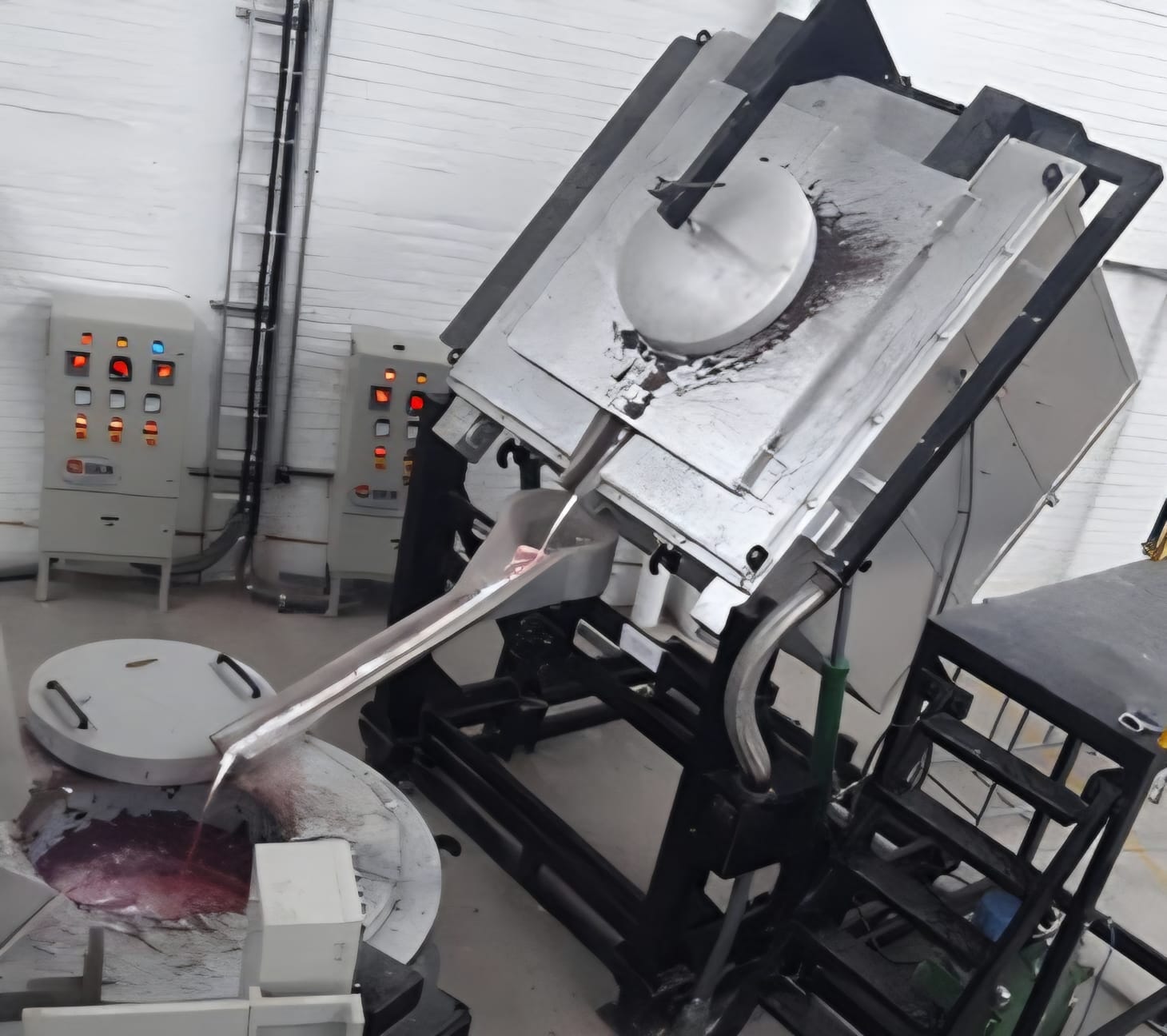
Aluminium Homogenizing Furnace
Homogenizing furnace is typically used for heat treatment of aluminum billet after casting process, it aims at eliminating residual stress produced during casting and improving metallurgical results. It is a crucial unit for enhancing the quality of aluminum profiles. After being homogenized, internal elements of aluminum billet (e.g. Mg2Si and Fe) are consistent. The homogenizing process features less mold consumption and improved surface quality of billet. A full set of homogenizing furnace consists of homogenization chamber, changing machine (transfer car) and cooling chamber. In the homogenizing furnace, aluminum billet will be heated up to 570℃(±5℃) or process required temperature, then cooled rapidly within a short period, ensuring efficient homogenizing for aluminum billets.
The life of pot ( cast iron or silicon carbide) which we use in these furnaces also increases as in oil fired furnaces, the pressure of blower remains on one side & as a result, the pot use to break from that particular side. But in our furnaces, there is uniform temperature due to which the life of pot increases & hence results in more & more saving. It is all automatically temperature control furnace which helps to operate the furnace in peaceful manner.
Specification
- Temperature Rang Up to 11000 C. (optimum range around 550°C–600°C)
- Temperature Uniformity: ±3°C to ±5°C across the heating chamber
- Batch Capacity: Range from 2,000 kg up to 50,000 kg (50 MT) or higher
- Form 50 to 1800 KW.
- Process Cycle Time: Typically 4 to 24 hours depending on alloy thickness and load weight
- Insulation – Vacuum Formed Ceramic Fibre Boards / Ceramic Fibre Blanket & Module / Brick Lining
- Heating Media Options – Electric / Gas Fired / Oil Fired
- Heating Media: Electric resistance elements or gas/oil-fired recuperative burners Core Design & Operation Features
- Air Recirculation: Heavy-duty centrifugal blowers and directional baffles drive forced hot-air convection to prevent cold spots.
- Configurations: Available as batch-type bogie hearth/car bottom units or continuous walking-beam setups for high-volume lines.
- Automation: Managed via multi-zone PLC, SCADA software, and programmable digital PID controllers for automated loading, soaking cycles, and data logging.